
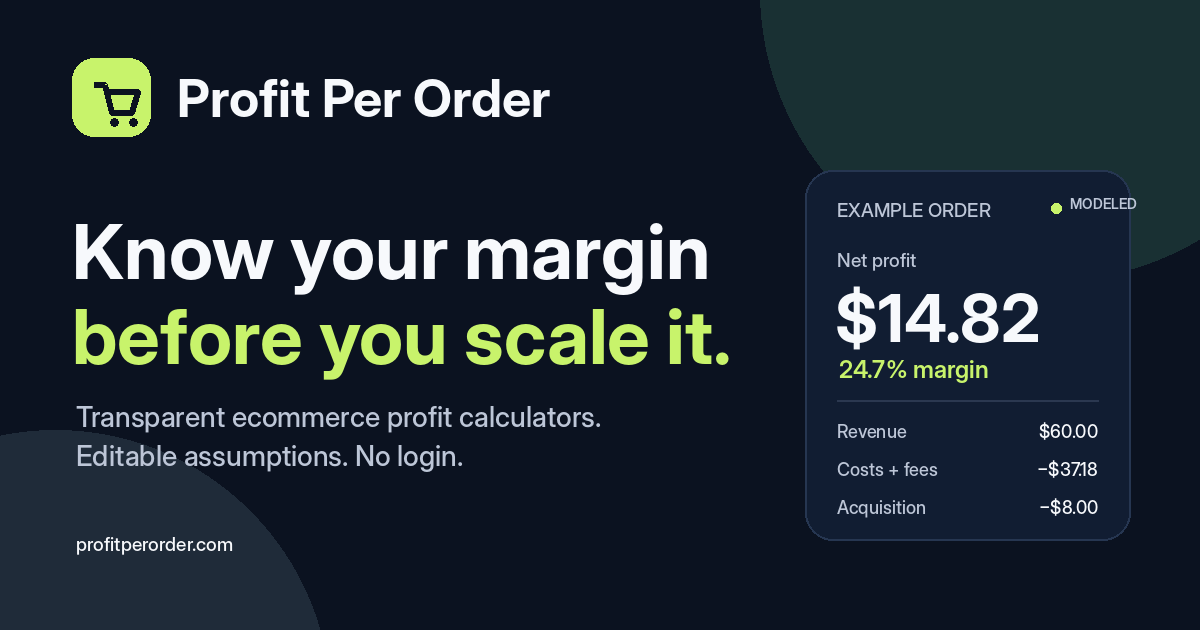
Profit Per Order is a set of transparent ecommerce unit-economics calculators with an optional private $19 decision report.
Press & directory kit
Accurate facts and descriptions for Profit Per Order.
Use this page when listing the product in a software directory, newsletter, resource library, podcast note or editorial article.
Approved descriptions
Copy that reflects the current product.
Profit Per Order helps ecommerce operators calculate fully loaded profit, break-even ROAS, marketplace fees, landed cost, returns, wholesale pricing and promotion economics. Formulas and assumptions are visible, the free tools require no account, and an optional one-time Profit Action Report turns one saved scenario into guardrails, sensitivity tests and a seven-day action sprint.
Ecommerce analytics; business calculators; unit economics; profitability software; pricing tools; marketing analytics; financial planning tools.
Independent ecommerce operators, marketplace sellers, Shopify brands, ecommerce accountants, bookkeepers, consultants, agencies and fractional CFOs.
Current facts
What is live now.
Facts are intentionally narrow. Do not describe Profit Per Order as bookkeeping software, tax advice, a payment processor or a guaranteed-profit system.
Free calculators
Ten editable ecommerce calculators with visible methods and no login requirement.
Paid product
Profit Action Report: one-time $19.00 purchase for one saved scenario. No subscription.
Delivery
Secure Stripe Checkout, private browser link and transactional email to the checkout address.
Method
Deterministic Python calculations. Optional AI can organize the completed result but does not own the math.
Launch date
Public production launch: August 2026.
Contact
Direct links
Send readers to the most useful destination.
Homepage
https://profitperorder.com/— broad product overview.Calculator library
https://profitperorder.com/calculators— all free calculators.Public report preview
https://profitperorder.com/profit-action-report/sample— selected illustrative output and the paid report structure.Advisor workflow
https://profitperorder.com/for-advisors— accountants, consultants, agencies and 3PL partners.
Launch copy
Copy-ready fields for free directory submissions.
Use the tracked destination for each platform so genuine referral traffic can be attributed. Never offer incentives for votes, reviews or links.
Transparent ecommerce profit calculators for decisions that affect every order.
Free ecommerce profit calculators for margin, ROAS, fees, landed cost, returns and pricing. Editable assumptions, visible formulas, no account required, plus an optional one-time $19 action report.
https://profitperorder.com/partner-resources
https://profitperorder.com/static/profitperorder-og.png
Product Hunt launch kit
Maker comment and launch-day answers.
Prepared for the planned September 1 launch. Keep the claims narrow, show the math, and use the tracked launch URL so referral calculations and checkout starts can be attributed.
Tracked Product Hunt URL
https://profitperorder.com/?utm_source=producthunt&utm_medium=referral&utm_campaign=launch_2026_09
Final maker comment
Why this product exists.
I built Profit Per Order because ecommerce decisions are often made from revenue, gross margin or ad-platform ROAS while shipping, payment fees, fulfillment, expected returns and discount leakage sit in different systems.
The site starts with ten free calculators. Inputs, assumptions and formulas are visible, and no account is required. A concrete example: a $60 order with $18 product cost, $6 shipping, $3 fulfillment, 3% + $0.30 payment fees, and an 8% expected return rate with an $18 loss per return leaves $29.46 of pre-ad contribution. That is about 2.04× break-even ROAS; keeping $10 of target profit moves the target to about 3.08×.
When someone wants a decision document rather than another calculator result, the optional one-time $19 Profit Action Report adds input checks, quantified opportunities, guardrails, downside/base/upside scenarios, a ranked five-step plan, a seven-day sprint and a downloadable action CSV.
The product is deliberately narrow: it is not bookkeeping software, tax advice or a guaranteed-profit system. I would especially value feedback on whether the report makes the next decision clearer, and which cost line ecommerce operators most often miss.
Launch-day FAQ
Short answers for comments and questions.
What is free?+
All ten public calculators are free, editable and usable without an account. The formulas and assumptions are visible.
What does the $19 report add?+
It turns one saved calculator scenario into a private decision brief with input checks, quantified opportunities, guardrails, scenarios, a ranked five-step plan, a seven-day sprint and downloadable action CSV. It does not change the calculator math.
Can I see the report before paying?+
Yes. The public preview shows selected illustrative outputs and what the paid report contains without publishing the ranked decision plan: view the report preview.
Does AI do the financial calculation?+
No. The financial outputs are deterministic Python calculations. Optional AI narrative can organize the completed result but does not own or change the math.
What happens to calculator data?+
Free calculator inputs are processed server-side to return the result, while the aggregate calculation event does not store the submitted financial values. A purchased report stores the submitted scenario and deterministic result so the private report can be generated and delivered. Stripe handles payment-card data.
How is a paid report delivered?+
After successful Stripe payment, the report is available at a private browser link and, when transactional email is enabled, that link is sent to the checkout email address.
What about refunds?+
Applicable refund rules, taxes and mandatory consumer rights form part of the purchase terms. Mandatory rights that cannot lawfully be excluded remain unaffected; the Terms of Use contain the current purchase boundary.
Who is it for?+
Independent ecommerce operators, marketplace sellers, Shopify brands and advisors who need a transparent unit-economics model rather than another opaque dashboard.
Editorial accuracy
Email the teamNeed a quote, correction or tailored calculation?
Send the intended context and deadline. We will answer with a concrete source, calculation or product fact where available.